


Stretching is underrated!
In fact, it is one component of fitness that a lot of us find way too easy to skip. But there are some benefits of stretching that might just make you want to stay with it.
While the research on stretching is a bit mixed, there are some sure mental and physical benefits to incorporating it into your routine, whether you stretch pre-workout, or at the end of your session, or another time during the day People who make time for stretching may find it helps their workouts—and daily life—feel better

But before we dig into those benefits, it can be helpful to understand what exactly we mean by stretching.
Stretching is basically any movement that lengthens your muscles (and along with them, the tendons, ligaments, and connective tissue) even temporarily.
Says physical therapist and strength coach Ivan Hernandez, D.P.T., C.S.C.S., owner of Executive Park PT and Wellness.
To get a little more specific, there are several different types of stretches. Static stretches involve moving into an end range of motion and then holding that position. Examples of static stretches include pulling your heel to your butt and holding it there to stretch your quad, or bending and pulling your elbow overhead to stretch your triceps.
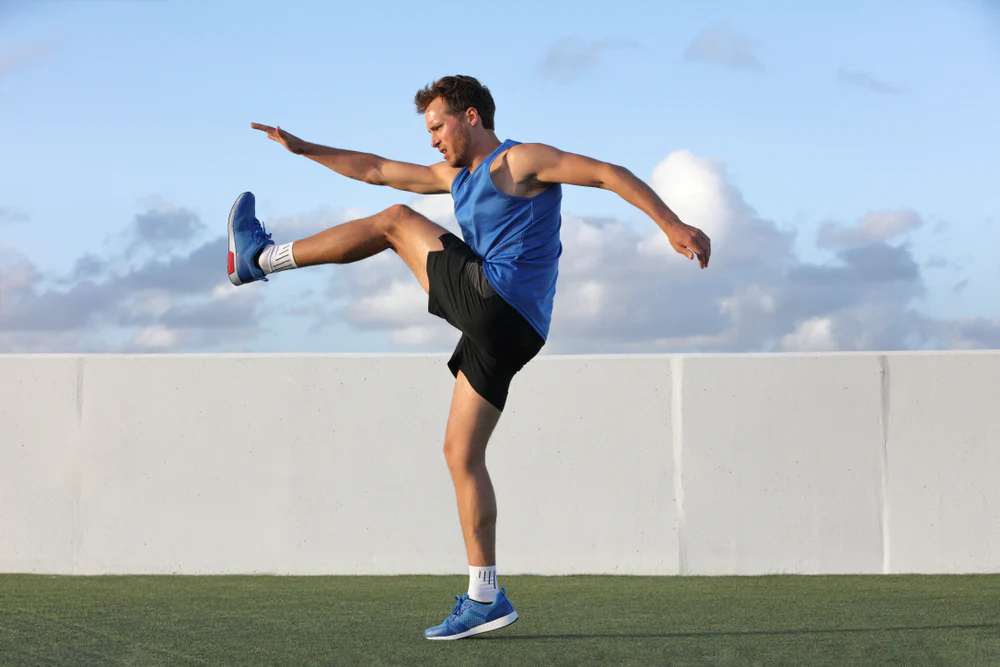
Dynamic stretches, on the other hand, involve active, controlled movements performed through a larger range of motion, the likes of walking lunges, arm circles, and deep squats are good examples of it. Dynamic stretches are done pre-workout as a way to prepare your muscles, tendons, and ligaments for exercise.
There are also ballistic stretches, which involve aggressively bouncing or otherwise moving into an end range of motion, and proprioceptive neuromuscular facilitation (PNF) stretches, which involve contracting and relaxing muscles as a way to increase a stretch. Because ballistic stretching is not recommended for the general population (it can be dangerous), and PNF stretching is often done with the assistance of a professional, we’re not going to focus on those two forms of stretching in this article.
Physical Benefits of Stretching
1. Stretching improves flexibility.
Flexibility is the range of motion of a joint, or group of joints. Stretching can help increase your range of motion—both temporarily and in the long-term. The temporary gains may be the result of your nervous system becoming more tolerant to a stretch position. These gains often disappear within a day or even a few hours. To actually lengthen the muscle and thus improve your range of motion long term, you need to stretch diligently about five to six days a week.
2. Stretching can help you better recruit your muscles when working out.
If you’re able to stick with a regular stretching routine, you may see only an increase in range of motion, but also improvement in your performance. The more range of motion you have, the more muscle you’ll be able to activate. For example, if you have limited range of motion in your hamstrings, you might only be able to activate, say, 40% of the muscle when performing a single-leg deadlift. But if you increase your hamstring flexibility, you can then activate, say 60%, of that muscle.
The result? You’ll gain strength, which would allow you to lift more weight—and thus get even stronger. Having more range of motion can also help you perform a broader range of exercises.
3. Stretching makes day-to-day life feel easier.
Increasing your flexibility won’t just improve your workouts—it can also make everyday life better, too, says Ford. You may not realize it, but there are a lot of daily tasks that involve some level of flexibility. Like squatting to sink in and out of a chair, leaning over to get in your car, and bending down to scoop up your toddler. By boosting your flexibility with stretching, you’ll be able to perform these small but essential day-to-day movements more easily and effectively.
4. Stretching primes you for your workout.
Experts typically recommend dynamic stretches before a workout. That’s because pre-workout dynamic stretches are a way of moving slow before you move fast.

“You’re preparing your body to work efficiently in order to both produce and absorb high forces”
Dynamic stretches can also help fire up the mind-muscle connection. The mind-muscle connection is basically the notion that you can help your muscles work more efficiently during a workout just by thinking about the ones you are activating as you move. For example, if you have a solid mind-muscle connection when you’re deadlifting, you can make sure that your hamstrings and glutes are engaging and doing the work rather than your lower back.
5. Stretching may decrease your risk of injury.
Take a squat for example. If you tried to do the movement without warming up first, you wouldn’t be able to sink as low and usually to compensate for that shortened range of motion, you might lean forward, which could stress your back, or turn your knees in, which could cause pain on the outside of that joint.
If you dynamically warm up first and then squat, you have a better chance of actually nailing the move, pain-free.
6. Stretching helps calm your body after exercise.
It’s important to give your body time to cool down after a workout before you go on about the rest of your day, says Patel. Doing so will help lower your heart rate, calm your breathing, and more quickly ease you out of the heightened state you were in while exercising. One way to achieve this calmed state is to do static stretching combined with deep breathing.
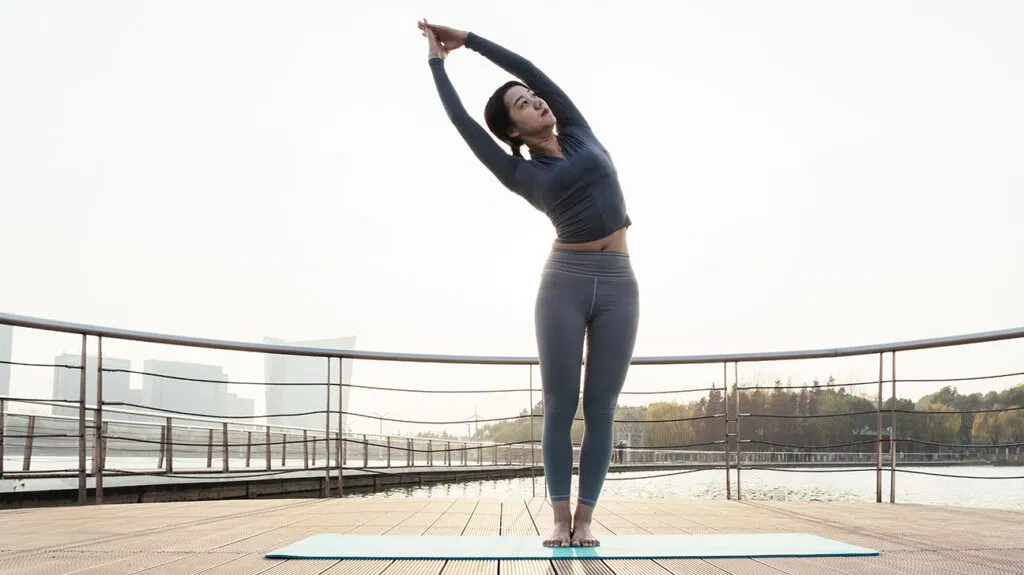
Stretching after a workout can also increase blood flow, boost oxygen levels, help deliver nutrients to your body and your muscles, and help aid with the recovery process.
7. Stretching can pinpoint bodily imbalances.
Stretching can be a great way to identify imbalances in flexibility or areas of extra tightness in the body, which then gives you a chance to correct those problem areas before they lead to injury.
For example, say you’re stretching your hips in a lunging hip flexor stretch and notice that you’re able to sink deeper into the stretch on your right side compared to your left. That discrepancy would alert you to the fact that you have an imbalance in hip openness that’s probably also showing up when you do exercises involving the hips, like running, squatting, and lunging.

With that intel, you can then be extra careful to work your hips evenly through their full range of motion whenever you perform exercises involving the hips. You may also want to add more unilateral exercises into your routine to further combat the imbalance.
8. Stretching can improve achiness.
If you work a traditional desk job, you’re probably sitting for eight hours or more every day. And now, thanks to stay-at-home life, many of us are spending even more time on our butts after the workday wraps.

All that time in the same position can cause certain muscles, like your hip flexors, to shorten and feel “tight”
A consistent static stretching routine can help reverse that shortening and alleviate that achy sensation by increasing flexibility in the muscle. You can also combat that tightness by simply moving more during the day.
A simple way to achieve that is to do five minutes of dynamic stretching every hour. For instance, hip circles and swinging arm hugs. These brief bursts of activity will help a lot!
Mental Benefits of Stretching
1. Stretching helps you relax!
For a lot of people, stretching just feels good. And things that make us feel good—can help reduce chronic stress and bring us closer to a calmer state.
Make stretching a focused undertaking as it can be especially relaxing mentally if you pair it with deep breathing. Every time you release a deep breath, imagine you’re letting go of a stressor in your life and then sink a tiny bit lower into the stretch. Just make sure you’re not stretching to the point of pain.
2. Stretching is an act of self-care.
The movement not only provides a sense of release and helps you feel connected to your body, but it can also serve as a powerful reminder that you took the time to do something restorative for yourself.

3. Stretching ends your workout on a positive note.
Doing some gentle stretches can help you end your workout on a happier, calmer note. And if doing those gentle stretches makes you think more positively about the workout in general and thus more likely to do it again, then that right there is a benefit.
Pro Tips
While stretching can be an important addition to any exercise routine, there are some things you should keep in mind to get the most out of it.
1. When you stretch matters.
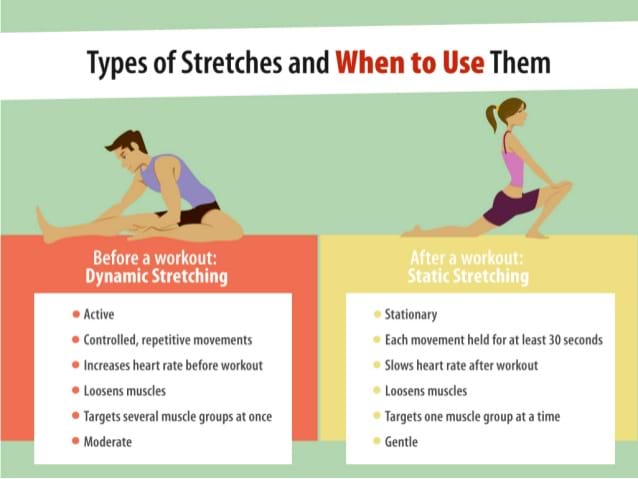
Dynamic and static stretches have different timing: Dynamic stretches, as we mentioned, should be performed before your workout.
Static stretching, on the other hand, can be detrimental to your workout if you do it beforehand, so it is better to save it for your cool-down or for some active recovery on your rest day. A note here: If you’re doing static stretching on its own, just make sure you warm up your muscles first. Simple movements like jumping jacks, arm swings, and walking up and down the stairs should be enough.
2. Certain stretches are more effective for certain workouts.
If you’re stretching pre-workout, it’s a good idea to focus on dynamic stretches that activate muscles you’re going to be using in your workout. For stretching after your workout, you want to pick stretches that target the muscles you just worked. for example, after a run, you might want to include stretches like the inchworm (which hits your hamstrings), plus the runner’s lunge with rotation (which hits your quads and hip flexors).
3. You don’t have to hold your stretches for ages.
The pro recommendation is to hold static stretches for a minimum of 30 seconds. That should give you enough time to feel your muscle initially contract against the stretch (part of the body’s natural response to stretching), and then slowly, after about 10 seconds, you should feel that contraction relax. At that point, you can lean a little bit further into the stretch.
Just make sure you listen to your body and don’t push too far.
Release the stretch after about 60 seconds, or sooner if you want. Holding it for more than a minute isn’t going to provide any additional muscle lengthening benefits.

